

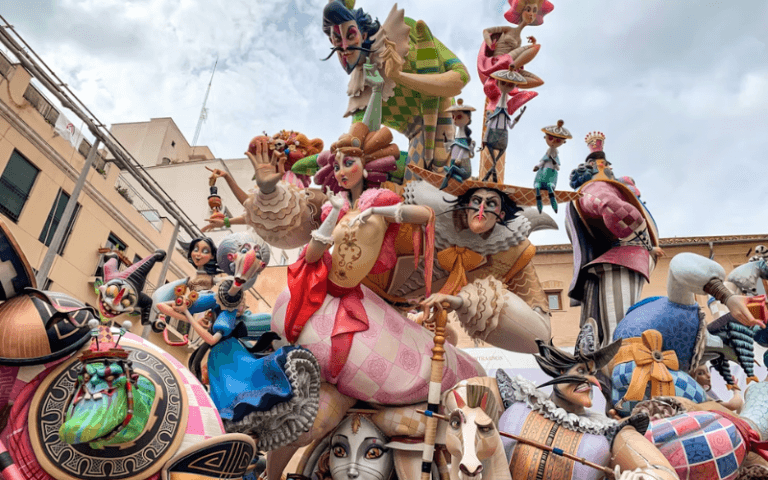
Every March, the city of Valencia transforms into an open-air museum, a fireworks stage, and a deeply emotional celebration of identity. Las Fallas is not simply a festival — it is a centuries-old tradition that blends satire, craftsmanship, community pride, and fire in a way that is uniquely Valencian.
For international visitors and residents, understanding Las Fallas means looking beyond the spectacle and discovering the cultural depth that sustains it.
What are Las Fallas?
Las Fallas takes place annually from 15th to 19th March, although preparations begin months in advance. The festival is rooted in an old carpenters’ tradition of burning wooden structures at the end of winter. Over time, these simple bonfires evolved into elaborate artistic monuments known as fallas — large sculptural installations, often satirical, that comment on politics, society, and contemporary culture.
Today, hundreds of these monuments are constructed across the city by neighbourhood associations called casales falleros. Each district commissions its own falla, competing for artistic recognition while reinforcing strong community bonds.
The art of the Falla
A true local will tell you that the fallas are much more than colourful figures. They are works of art, sometimes reaching over 20 metres in height, created by specialised artists and workshops. Each monument contains multiple scenes and characters (ninots), carefully designed with humour and irony.
On 19th March, during La Cremà, these sculptures are set alight in a carefully choreographed burning ceremony. For visitors, it may seem surprising that such artistic effort ends in flames — but for Valencians, this is the essence of the tradition: renewal, letting go, and starting again.

Fireworks, music, and daily rituals
From early morning until late at night, the city pulses with energy. The mascletà, a daily midday fireworks display in the Plaza del Ayuntamiento, is not about visual spectacle but about rhythm and sound. Locals don’t simply watch it — they feel it. The ground vibrates beneath your feet, and the sequence of explosions builds like a musical composition.
Traditional dress also plays a central role. Women wear intricate silk gowns inspired by 18th-century fashion, while men dress in historic Valencian attire. Throughout the week, floral offerings are made to the Virgin of the Forsaken (Virgen de los Desamparados), forming an enormous tapestry of flowers in the city centre.

Experiencing Valencia beyond the festival
While Las Fallas is the most internationally recognised Valencian festivity, it also reflects the broader lifestyle of the region: Mediterranean living, strong local identity, and a culture that values both celebration and craftsmanship.
For those considering living in Valencia, understanding Las Fallas provides more than a festive anecdote — it offers a glimpse into the social fabric of the city. It reveals a place where tradition is not preserved behind glass, but lived fully, passionately, and collectively.